
SaaS & Product Engineering
Building an integrated restaurant management platform from the ground up
Building a connected restaurant management platform for everyday operations.
Overview
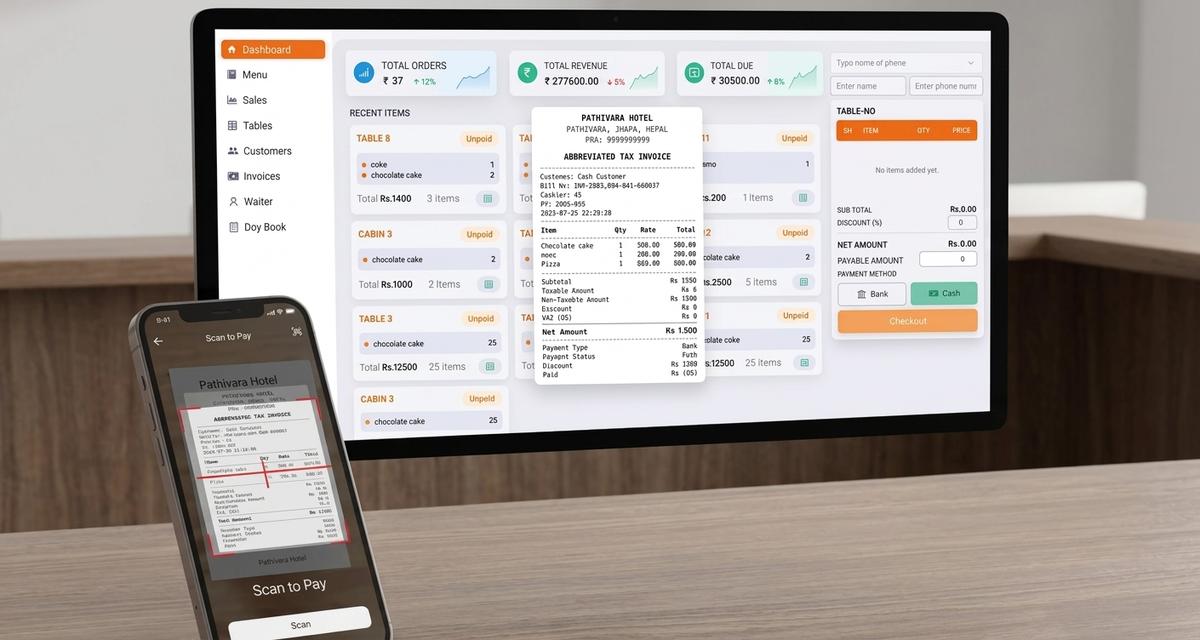
Parikaar OS is a restaurant management platform developed by Byte Gurkha to bring essential restaurant operations into one connected system.
The platform connects customer ordering, waiter operations, kitchen workflows, billing, payments, and sales tracking. It is designed to help restaurant teams manage their daily activities through a centralized platform instead of depending on disconnected tools and manual processes.
From placing an order through a QR code to processing payments and reviewing daily sales, Parikaar OS connects different stages of restaurant operations through a structured digital workflow.
The Challenge
Restaurant operations involve several interconnected activities. Customer orders need to reach the right staff, kitchen teams need to manage incoming requests, payments must be recorded accurately, and administrators need access to reliable sales and financial records.
When these activities are handled through separate tools or manual processes, managing order status, coordinating staff, maintaining payment records, and reviewing daily performance can become difficult.
The objective was to develop a unified restaurant management solution that could handle these workflows while keeping different restaurant roles, responsibilities, and operational data organized.
Our Approach
Byte Gurkha approached Parikaar OS as a complete software product rather than a basic point-of-sale application. The focus was on connecting restaurant workflows, designing role-specific interfaces, and building a centralized backend to manage operational data.
We developed separate modules for administrators, waiters, and kitchen staff, allowing each team to access the functionality relevant to its responsibilities.
Real-time communication was incorporated to keep order-related activities synchronized across modules, while structured database management supports billing, payments, and daily operational records.
Key features
QR-Based Customer Ordering
Customers can scan a restaurant's QR code, browse the available menu, and place orders directly from their smartphones. The ordering experience is connected to the restaurant's operational system, reducing the need for staff to manually transfer customer orders.
Real-Time Order Management
Orders move between the customer ordering interface, waiter module, and kitchen module through connected workflows. Staff can receive and manage incoming orders and follow their progress without relying on separate communication channels.
Dedicated Kitchen Management
Kitchen staff have a dedicated interface for viewing incoming orders and managing preparation activities. This helps organize kitchen operations and keeps order information accessible to the relevant team members.
Billing and Invoice Management
The platform supports invoice generation and restaurant billing workflows. Administrators can manage finalized invoices and maintain organized transaction records as part of the restaurant's daily operations.
Payment and Customer Due Management
The system supports cash and bank payment records, along with customer due handling. Payment information is connected to billing workflows to help maintain consistent transaction records.
Sales and Daybook Management
Administrators can review sales information, payment records, and daybook entries from a centralized dashboard. This brings important daily financial information into one place for easier monitoring and record management.
Role-Based Access and Interfaces
Parikaar OS provides separate access and interfaces for Super Admin, Restaurant Admin, Waiter, and Kitchen roles. This organizes system access according to responsibilities and helps keep operational workflows structured.
Engineering & Technology
We used a modern full-stack technology stack to develop Parikaar OS, with a focus on maintainable application architecture, structured data management, and real-time communication between operational modules.
Technologies used
- Frontend
- React
- TypeScript
- Backend
- Node.js
- Express.js
- Database & ORM
- PostgreSQL
- Prisma
- Real-Time Communication
- Socket.IO
- Media Management
- Cloudinary
The frontend was developed with React and TypeScript to support separate application interfaces and structured interactions across different user roles.
The backend uses Node.js and Express.js to handle business logic, API communication, authentication, and operational workflows. PostgreSQL provides relational data storage, with Prisma used for database access and schema management.
Socket.IO enables real-time communication between connected modules, particularly for order-related updates. Cloudinary handles media management.
Together, these technologies provide the foundation for a connected restaurant management application with multiple user roles and interconnected business processes.
The Outcome
Byte Gurkha developed Parikaar OS into an integrated restaurant management platform covering essential workflows from customer ordering and kitchen operations to billing, payments, and sales records.
Instead of treating these activities as separate applications, the platform brings them together through connected modules and centralized data management.
The project reflects our experience in building complete SaaS products, multi-role applications, real-time systems, and database-driven business software.